
Black Friday is one week away, and portable power stations are about to be everywhere: big glossy boxes with big glossy numbers on the front, all promising to keep your life running when the power goes out. Some of them will be great buys. Some will be great buys for somebody else. The difference usually comes down to five minutes of grade-school math that almost nobody does before clicking “Add to Cart.”
So let’s do it together. No electrical degree needed, just a pencil, the sticker on the back of your fridge, and the willingness to multiply. By the end you’ll know what size power station fits your house, what the numbers on the box actually mean, and the one appliance that will empty any of them faster than a teenager empties a bag of pizza rolls.
The two numbers on the box (and why they’re not the same thing)
Every power station lists two headline numbers, and mixing them up is the number one shopping mistake.
- Watts (W) is muscle. It’s how much power the station can push out at one moment. Think of it as the width of a garden hose. A 1,500-watt station can run anything up to 1,500 watts at once, but not a 1,800-watt hair dryer.
- Watt-hours (Wh) is the gas tank. It’s how much energy is stored in total. A 1,000 Wh station could, in theory, run a 100-watt device for 10 hours, or a 1,000-watt device for 1 hour.
Here’s the trap: the model name often doesn’t match either number. Take the Jackery Explorer 1000 v2, a popular model we’ll use as our example all the way through. Its name says 1000. The current Amazon listing says it holds 1,024 Wh and puts out 1,500 watts, with a 3,000-watt surge peak. Jackery’s own older guide for the same model lists it at 1,070 Wh. Same name, three different numbers floating around. Lesson one: ignore the name and read the spec line for the exact box you’re buying.
Step 1: Make your “must-run” list
Write down only the things you genuinely need during an outage. Not “everything in the kitchen.” For most households it’s some mix of the fridge, Wi-Fi, a couple of lights, phones, maybe a laptop for work, and any medical device like a CPAP. The shorter the list, the smaller (and cheaper) the station you need.
Step 2: Find out how much each thing actually uses
There are three ways to get real numbers, from best to worst:
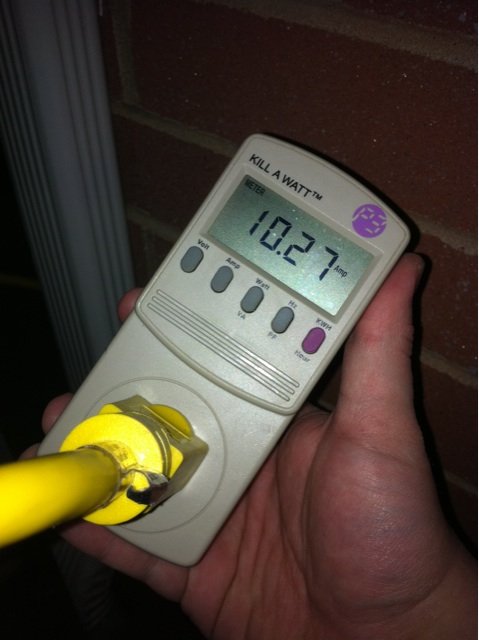
- Measure it. A plug-in meter like the P3 Kill A Watt P4400 plug-in electricity meter sits between the wall and your appliance and shows the real watts, plus total energy used over a day. Plug the fridge into it for 24 hours and you’ll know exactly what it eats, no guessing.
- Read the yellow EnergyGuide label. Fridges and freezers come with one. It lists the estimated yearly electricity use in kilowatt-hours. Divide that by 365 and you’ve got your daily use. (A kilowatt-hour is just 1,000 watt-hours.)
- Use a published chart as a last resort. Honda’s generator wattage guide is a solid one. It lists an Energy Star fridge at roughly 132 to 192 watts while running.
Why does the fridge label beat the chart? Because a fridge doesn’t run all the time. The compressor kicks on, cools things down, and shuts off. Say your EnergyGuide label reads 500 kWh per year. That’s about 1,370 watt-hours a day, or only about 57 watt-hours per hour on average, a lot less than the 132 to 192 watts it pulls while the motor is actually running.
Step 3: Do the math (it’s one formula)
For each item, multiply watts × hours you’ll run it. Add everything up. Then divide by 0.85. That last step matters: a power station loses some energy turning its battery power into wall-outlet power. Jackery’s own runtime formula multiplies capacity by 0.85 to account for that loss, so a 1,024 Wh station really gives you about 870 watt-hours of usable outlet power.
In plain English: whatever number you get from adding up your list, you need a station about 18% bigger than that.
Three worked examples
Example 1: Get through a 12-hour overnight outage
- Fridge (that 500 kWh-per-year label): 57 Wh × 12 hours = about 685 Wh
- Modem and router, say 20 watts (check yours with a meter): 20 × 12 = 240 Wh
- Two 10-watt LED lamps for 5 hours: 2 × 10 × 5 = 100 Wh
- Phones for the family, a generous cushion: 50 Wh
Total: about 1,075 Wh. Our example station gives about 870. So it comes up short by roughly 200 Wh. You have two choices: buy bigger, or get smart. Here’s the smart move. FoodSafety.gov says a closed fridge keeps food safe for up to 4 hours without power. If you unplug the fridge for a couple of stretches overnight (door shut, well inside that 4-hour window) so it only runs about 8 of the 12 hours, it drops to about 457 Wh. New total: about 847 Wh. Now it fits, barely. We covered the full keep-or-toss food rules in our Thanksgiving outage guide.
Example 2: Work from home on Starlink for a day
Rural folks, this one’s for you. Starlink publishes its own power numbers: the Standard kit averages 75 to 100 watts and the Mini averages 25 to 40 watts.
- Starlink Standard at the high end: 100 × 8 hours = 800 Wh
- Laptop, say 45 watts measured (the 65-watt rating on the charger brick is its maximum, not its typical draw): 45 × 8 = 360 Wh
Total: 1,160 Wh. That blows past our 870 Wh station. Swap in the Mini at 40 watts and the dish only needs 320 Wh, for a total of 680 Wh, with room to spare. Same station, same workday, completely different answer. Sometimes the cheapest upgrade isn’t a bigger battery. It’s a smaller appetite.
Example 3: The space heater “just for a little while”
Honda’s chart lists a radiant heater at about 1,300 watts. Divide our 870 usable watt-hours by 1,300 and you get about two-thirds of an hour. Forty minutes of warm toes, then a dead battery and a cold, dark house. A power station is a fantastic way to run a fridge and Wi-Fi. It’s a terrible way to heat a room. If you do use a space heater when the grid is up, read our space heater safety rules first.
Step 4: Check the “kick” when motors start
Anything with a motor or compressor gulps extra power for a second or two when it starts. Honda’s chart lists an Energy Star fridge at about 1,200 starting watts, way more than its running watts. Our example station handles that easily (1,500 watts steady, 3,000 surge). But try a microwave and it gets tight: Honda lists a 1,000-watt microwave at about 1,500 watts, right at this station’s ceiling. Rule of thumb: the biggest single thing you’ll plug in should sit comfortably under the station’s steady watt rating.
If you like this kind of math, our solar install math cheat sheet goes deeper on fridge runtime and battery wiring.
What a two-year solar setup teaches about the box on the shelf
Andrew has run an EG4 off-grid solar system at home in Mountain Grove, Missouri, for about two years. It’s a different animal from a suitcase-size station: a ground-mount array and a stack of server-rack batteries instead of one box with a handle. But the rules that keep a big system honest are the exact same ones above. Watts times hours equals watt-hours. You only get back what’s stored, minus losses. And the battery is only half the story. The other half is how it gets refilled.

That refill question is where a lot of power station buyers get surprised. A station with no way to recharge during a long outage is basically a countdown clock. Before you buy, check how it charges: wall, car, and solar. Look closely at solar. The current Amazon listing for our example Jackery says it’s compatible only with Jackery’s own solar panels for solar charging, and Jackery says two of its 200-watt SolarSaga panels can refill it in about 3.8 hours in ideal conditions. Other brands have their own rules about which panels and voltages they accept. Read that fine print before you buy panels, not after.
Your Black Friday checklist before you click Buy
- Do your Step 3 math first. Know your total watt-hours and divide by 0.85 before you look at a single deal.
- Read watt-hours and watts, not the model name. Confirm both on the exact listing.
- Prefer LiFePO4 (often shown as LFP) batteries. This battery chemistry is known for long life. Our example is rated to keep over 70% of its capacity after 4,000 charge cycles, which works out to more than 10 years of one cycle a day.
- Look for “pure sine wave” AC outlets. That means the outlets put out smooth power like your wall does, which matters for sensitive electronics.
- Want it to act like a battery backup? Some stations offer UPS mode. Our example lists a 10-millisecond switchover, meaning if the grid drops, it takes over almost instantly, like a relay runner grabbing the baton. Handy for Wi-Fi or a CPAP. Ask your medical equipment supplier how your specific device should be powered in an outage.
- Check solar compatibility if you ever plan to recharge from the sun.
- Search the model on CPSC.gov/Recalls. Power stations do get recalled. In August 2026, Goal Zero recalled about 46,200 YETI 3000X power stations because the circuit board can overheat. The fix is a free firmware update.
- Buy from a store you know is real. Fake shops love big-ticket holiday items. Here’s our 60-second check for fake stores.
- Not a plane gadget. The FAA limits spare lithium batteries to 100 Wh, or up to 160 Wh with airline approval, in carry-on bags only, and TSA says the same. A 1,000 Wh station is a drive-to-Grandma’s gadget, not a fly-to-Grandma’s gadget.
Why it matters to you
A power station is one of the most useful things you can own in outage season. It’s quiet, it makes no fumes, so it’s safe to use indoors, and it can keep your food cold and your family connected. But it’s also a few hundred dollars or more, and the wrong size fails you one of two ways. Too small, and it dies at 2 a.m. with the fridge still warm. Too big, and you paid for a battery you’ll never use. Five minutes with a pencil, the fridge label, and the formula above beats any “limited time” banner, because a deal on the wrong size is no deal at all.
Products mentioned
- P3 Kill A Watt P4400 plug-in electricity meter: the easiest way to measure what your fridge, router or CPAP really uses before you buy.
- Jackery Explorer 1000 v2: the example station used in the worked examples above (1,024 Wh and 1,500 watts per its current listing). Run your own numbers before deciding it’s the right size for you.
As an Amazon Associate I earn from qualifying purchases.
Did the math and still not sure what size fits your house? Send your must-run list through our Contact Us page.
Want more plain-English power and prep tips? Come hang out on Andrew’s YouTube channel.
Sources
- Amazon: Jackery Explorer 1000 v2 listing (capacity, output, LFP cycle rating, UPS and solar compatibility; checked Nov. 20, 2026)
- Jackery: What Can Jackery 1000 v2 Run? (updated Aug. 19, 2026)
- Jackery: Can Jackery Power a Toaster? (runtime formula with 0.85 factor; updated Sept. 28, 2026)
- Honda Power Equipment: Generator wattage estimation guide
- Starlink: Standard kit specification sheet
- Starlink: Mini specification sheet
- Consumer Reports: How to read an EnergyGuide label
- FoodSafety.gov: Food Safety During Power Outage
- CPSC: Goal Zero recalls YETI 3000X power stations (Aug. 20, 2026)
- FAA PackSafe: Lithium batteries
- TSA: Lithium batteries with more than 100 watt hours




More Stories
Own an EG4 Solar Inverter? Here’s the 15-Minute Security Check Worth Doing Tonight
Renters Are Getting Paid to Plug In a Battery. Here’s How a ‘Power Plant’ Fits Behind Your Couch
Selling Your Solar Power Back for Pennies? Using It at Home Can Pay Off the Panels Years Sooner