
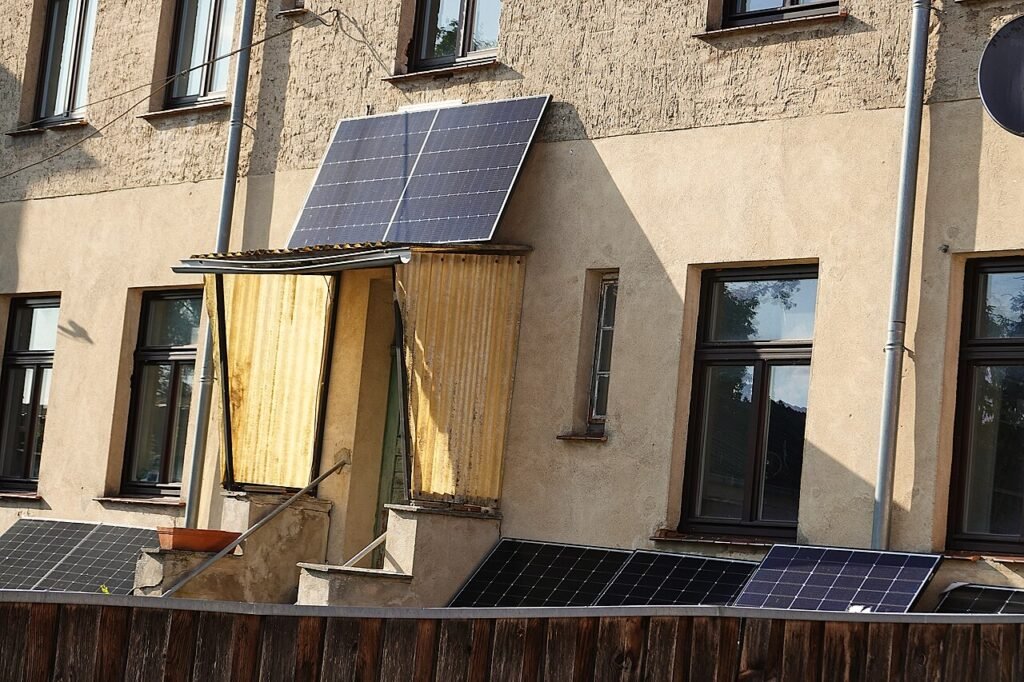
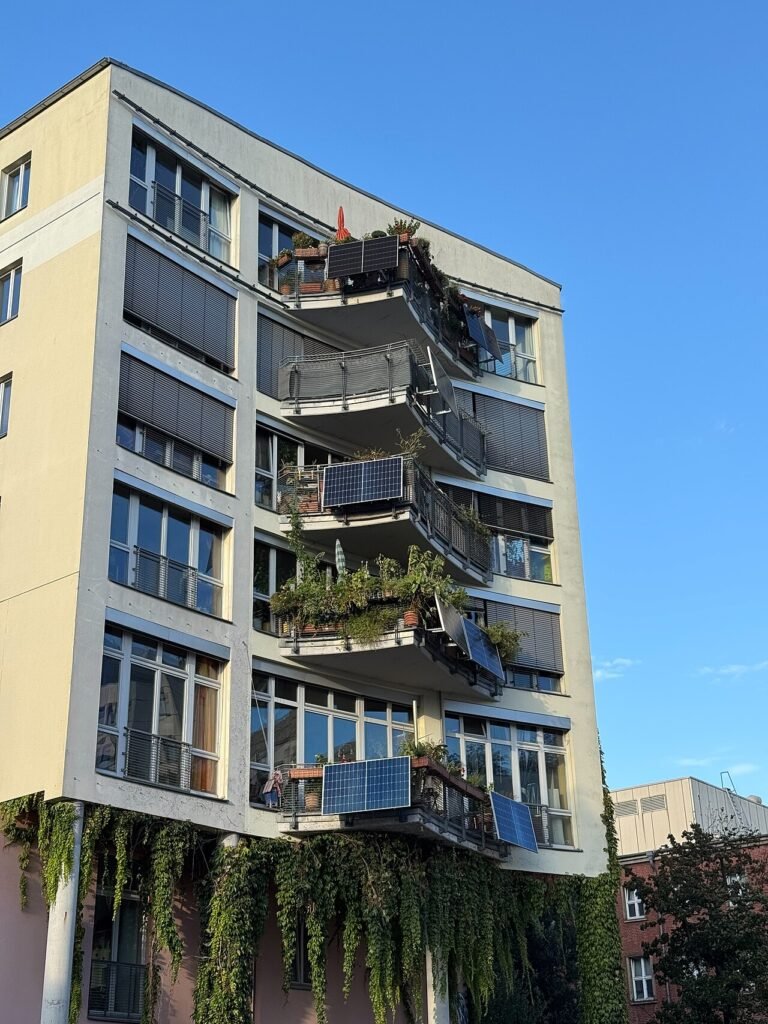
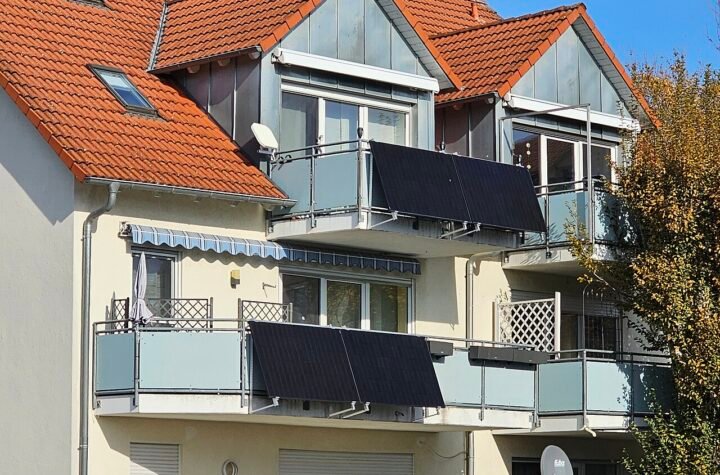
Balcony solar on an apartment building in Germany. Photo: Nikolai Twin, Wikimedia Commons, CC BY 4.0
Imagine buying a solar panel at the hardware store, leaning it against your back fence, and plugging it into an outdoor outlet like a string of Christmas lights. No roofers, no permit pile, no three-month wait for the power company to call you back. In Germany, people have been doing this for years. Now it’s finally coming to the U.S., one state at a time.
This week, the nonprofits Solar United Neighbors and Bright Saver released a new Plug-In Solar Consumer Guide, and the timing isn’t an accident. According to North American Clean Energy, which covered the release on November 13, Utah was the only state that had cleared the way for plug-in solar at the start of 2026. Now 10 states have passed laws allowing it, and 36 states saw bills introduced this year. Here’s what it is, what it really saves, the big catch most people miss, and how to tell if you can use it.
What is plug-in solar, exactly?
Plug-in solar, often called “balcony solar,” is a small solar setup, usually one to a few panels, with a little box called a microinverter attached. The panel makes DC power, the microinverter turns it into the same AC power your outlets use, and a cord plugs it into a regular wall outlet. Whatever the panel makes gets used first by anything running in your house, like your fridge, Wi-Fi router or TV, so you buy less from the power company.
It’s tiny compared to rooftop solar. The guide says plug-in systems are usually 1,200 watts or less, while a typical rooftop system is 3,000 to 9,000 watts. Think of it as a solar “side dish” rather than the whole meal. It won’t erase your bill, but it can take a bite out of it every sunny day.
On KCRA’s California Tonight show on November 12, Bernadette Del Chiarro of the Environmental Working Group, who helped pass California’s new law, showed off a demo panel about 2 feet by 3 feet that makes 180 watts. She told KCRA it can go “any place where you have a small patch of sunlight and a nearby outlet,” whether that’s a balcony, a deck or leaned against a backyard fence.
The 10 states where it’s legal (and when)
Here’s the list from the Solar United Neighbors guide, current as of October 2026. Some of these laws are already in effect, and others start soon:
- Utah: in effect since May 7, 2025, up to 1,200 watts.
- Maine, Vermont and Maryland: in effect since July 1, 2026. Maine allows one 420-watt system without an electrician; bigger ones need a pro.
- Connecticut: in effect since October 1, 2026, one plug-in device per meter.
- California, Colorado, Virginia and New Hampshire: start January 1, 2027.
- New Jersey: starts March 1, 2027.
California’s law, SB 868, is a big deal because of what it removes. Del Chiarro told KCRA that the utility paperwork alone used to cost $150 just to submit, which she called “completely prohibitive.” The new law drops the need for utility approval, though the guide notes utilities can still ask for a simple online form with your address and the system’s make, model and size.
And the list is growing. A New Orleans City Council committee is set to vote Monday, November 16, on opening a review of plug-in solar rules, New Orleans CityBusiness reported. In Colorado, a new nonprofit called Solar Access Colorado has started taking pre-orders for small kits ahead of the state’s law, according to Solar Power World.
What it costs and what it really saves
The guide says plug-in systems generally cost $400 to $2,000, and that “a typical plug-in system can cut your electricity bills by several hundred dollars per year,” with an average payback of about five years for systems bought today. The bigger 1,200-watt setups are the ones that get you into “several hundred dollars” territory.
A single small panel is more modest. Del Chiarro said her roughly $500 demo panel would save “around $100 a year,” and admitted “it would take a while for it to pay for itself.” The panels are warrantied and should last around 20 years, so a five-year payback means about 15 years of mostly free electricity after that. Not bad for something you can set up in less time than it takes to assemble a bookshelf, with fewer leftover screws.
Here’s a rough way to think about it (my math, not the guide’s). A 400-watt setup that gets about four hours of good sun makes around 1.6 kilowatt-hours a day, or roughly 580 a year. At 15 cents per kilowatt-hour, that’s about $88 a year. Where you live, which way the panel faces, shade, and your local electric rate can swing that a lot in either direction. The guide includes a state-by-state savings map if you want a better estimate.
The big catch: it won’t keep your lights on in an outage
This is the part a lot of people get wrong, and it matters for anybody who reads this site for prepping tips. A plug-in solar system is built to shut itself off when the grid goes down. The guide says the microinverter must stop sending power within 160 milliseconds of an outage. That’s a good thing, because it keeps line workers from getting shocked by power flowing backward into lines they think are dead.
But it means that during a blackout, your shiny new balcony panel is basically patio decor. Plug-in solar is a bill-saver, not a backup plan. The guide notes that pairing it with a battery can let you store power for later, like charging your phone or running your fridge when the power is out. If outages are your main worry, a battery or power station is the piece you actually need.
Before you buy: the checklist
The market is brand new, and the guide is honest that it’s a little messy right now. Here’s what to check first:
- Make sure your state actually allows it and that the law has taken effect. If your state isn’t on the list, plugging a solar kit into your wall can break your utility’s rules, so hold off.
- Look for safety certification. The laws require systems certified by UL or another nationally recognized testing lab. UL released its plug-in solar standard, called UL 3700, in December 2025, but the guide says no all-in-one plug-in kit in the U.S. has full system-level certification yet. Be wary of anyone who says theirs is “approved everywhere.”
- Tell your utility or landlord if your state requires it. Maine, Maryland, Virginia and California all have some kind of notification rule.
- Renters, read your lease. Colorado, New Jersey and Virginia added renter protections, and Vermont lets tenants install after giving the landlord 10 days’ notice.
- Check your HOA rules. Colorado, Vermont and New Jersey limit HOAs from banning these systems, but reasonable safety rules can still apply.
- Use common sense with outlets. Don’t bypass breakers, don’t overload the circuit, and follow the maker’s instructions to the letter.
Not in one of the 10 states? You still have options
If your state hasn’t passed a law yet, you’re not stuck. The legal headaches come from connecting solar to your home’s wiring. A solar setup that charges a battery and runs things directly, without ever tying into your house, doesn’t need utility permission. That’s exactly how I started: a small off-grid system running part of the house while we stayed on the grid.
The simplest version is a portable power station plus a folding panel. The next step up is a few panels, a charge controller or all-in-one inverter, and a battery bank. If you go the DIY route, Santan Solar (affiliate) sells new and used solar panels and gear, which can make that first system a lot cheaper. And unlike plug-in solar, a battery-based setup keeps working when the power goes out.
Why it matters to you
For years, solar had a membership card: you needed to own a house, have a good roof, and be ready to spend thousands of dollars. Plug-in solar tears up that card. Renters, apartment dwellers, people with shady roofs, and folks who just want to try solar without a big commitment can finally get in the game for a few hundred bucks.
It won’t replace a full rooftop system or a proper backup setup, and it’s not going to make your electric meter spin backward like a cartoon. But with electric bills climbing, a small, portable panel that pays for itself in about five years and moves with you when you move is a smart, low-risk way to start. If your state isn’t on the list yet, the guide suggests telling your state lawmakers you want it. With 36 states looking at bills this year, a quick email might actually be heard.
What I’d grab
Whether you’re waiting on your state or ready to build something now, these two make the decision a lot easier:
- P3 Kill A Watt P4400 electricity usage monitor: plug your fridge, window AC or chest freezer into this for a few days and it tells you exactly how many kWh it uses, so you know what a small solar setup could actually cover before you spend a dime.
- Jackery Explorer 1000 v2 portable power station: a battery you can charge from the wall or from portable panels and plug a fridge, CPAP or lights straight into. It needs no state law because it never connects to your home wiring, and it keeps working when the grid goes down.
As an Amazon Associate I earn from qualifying purchases.
The bottom line
Plug-in solar is legal in 10 states now, more are lining up, and the price of entry is a few hundred dollars instead of a few thousand. Check your state’s rules, buy only certified gear, and remember it’s a bill-shrinker, not a blackout plan. Sunshine is free. It’s about time more of us got to plug into it.
Is your state on the list, or are you still waiting? Tell me through the Contact Us page, and I’ll keep you posted as new states join.
Want to see real solar setups, mistakes and all? Check out my YouTube channel for honest solar reviews and DIY install videos.
Sources
- North American Clean Energy: As Plug-In Solar Takes Off Across U.S., New Consumer Guide Explains How to Get Started (Nov. 13, 2026)
- Solar United Neighbors and Bright Saver: Plug-In Solar Consumer Guide
- KCRA: New California law makes portable solar panels more accessible for renters, homeowners (Nov. 12, 2026)
- New Orleans CityBusiness: City Council committee to vote on plug-in solar review (Nov. 13, 2026)
- Solar Power World: Colorado nonprofit launches plug-in solar program ahead of new state law (Nov. 10, 2026)
Top photo: balcony solar on an apartment building in Germany by Nikolai Twin, Wikimedia Commons, CC BY 4.0.


More Stories
EG4 Just Launched a 60 kWh Home Battery in One Box. Here’s Who It Actually Makes Sense For
Heating Bills Are Jumping 7% This Winter. Here’s How to Shrink Yours Without Freezing
Solar Panels Rarely Start the Fire. The Wiring Behind Them Does. Here’s Your Home Safety Check